
Asafoetida (Hing)
Hing, scientifically known as Ferula assa-foetida, is widely recognized in the global market under the name of Hing or Asafoetida. The Hing plant has thick and fleshy roots. Its leaves are grassy with a dark green color. The stem of the Hing plant is strong, upright and fibrous, and the roots can reach a diameter of 13cm and penetrate up to 40cm into the soil.
Hing generally grows in dry and mountainous climates such as Afghanistan, Iran and Central Asian countries. The taste of Hing is mostly bitter, and its smell is similar to garlic but much stronger. Hing is harvested during the summer.
Flowering & Resin Extraction
Throughout its entire life cycle, the Asafoetida (Hing) plant produces flowers only once. The inflorescences
are yellow in color and appear as compound umbels at the terminal part of the stem.
In late spring, the resin of the Asafoetida (Hing) plant is obtained by cutting or scraping the roots and
lower parts of the stem. The extracted resin emits a strong and pungent odor and gradually hardens when
exposed to air during mid-summer, forming the product known as Hing.
Varieties of Hing
The lifespan of a Hing plant ranges from 10 to 20 years, and 28 varieties of the Hing (Asafoetida) plant
have been identified in Afghanistan. Among these, three types are the most well-known and commercially
significant in the country:
1: White Hing – the most common and widely traded type.
2: Red Hing.
3: Chaheer or Rough Hing.
Processed Forms of Hing
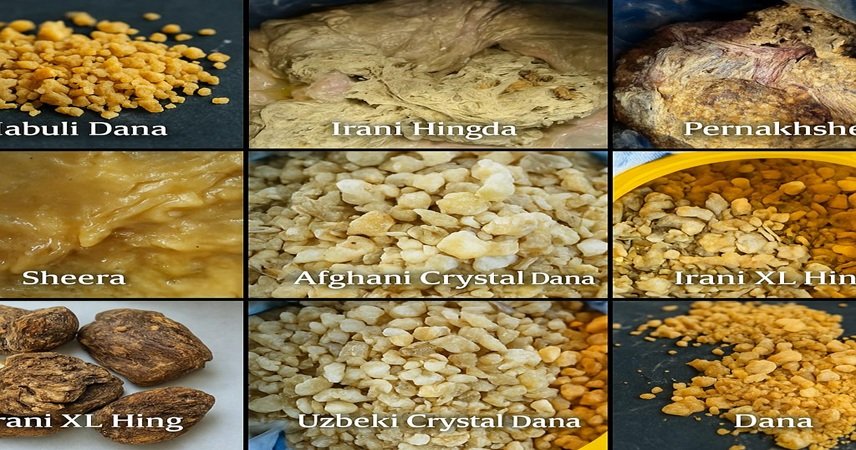
All kinds of Hing are processed into three main products: Dona, Sarkash and Shira.
Hing remains one of the most valuable natural resins due to its unique aroma, traditional uses, and significant role in both culinary and medicinal applications.